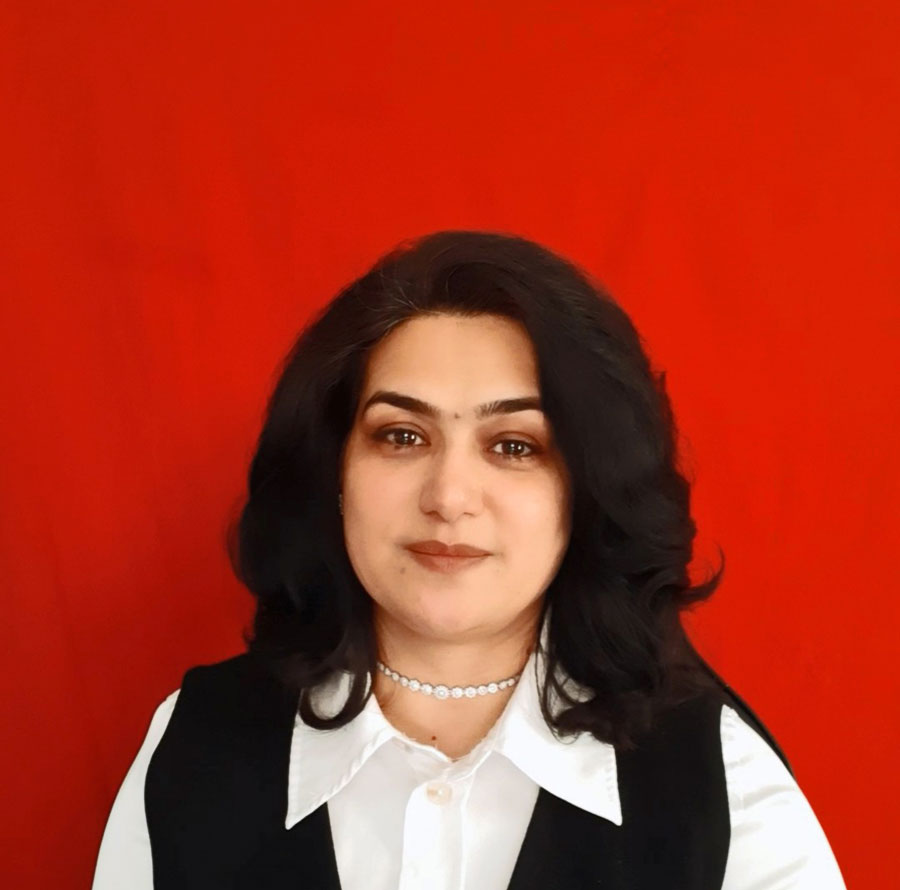
The artist
Helen Arjmandi
An Iranian-American artist who reworks the visual grammar of Persian illumination, calligraphy, and sacred geometry—through woodburning, engraving, gilding, mirror inlay, and richly layered contemporary mixed media.
The path
From Persian calligraphy to a contemporary practice
Helen began Persian calligraphy as a child and trained formally through a long apprenticeship, studying Nasta'liq and Shekasteh-Nasta'liq under masters Ali Akbar Rezvani and Safar Mirzazadeh. She earned an advanced degree from the Iranian Calligraphers Association in Quchan in 2001, and went on to expand her work into painting, digital design, and photography.
She immigrated to the United States in 2014 and now works from a studio in Connecticut, where her craft has grown to include woodburning, engraving, gilding, and mirror inlay at both intimate and architectural scale.
The practice
Two directions, one hand
One strand is heritage-based and highly crafted: Persian illumination (Tazhib), calligraphy and Naghashi-Khat, geometric and biomorphic pattern, miniature painting, gilding, and mirror-glass inlay—built into wood panels, furniture, and large decorative surfaces.
The other is contemporary and expressive: cracked, burned, eroded, and heavily layered surfaces that deal with wounds, rupture, memory, endurance, and the possibility of renewal. Gold is set into the deepest fractures—not to hide the damage, but to illuminate it.
Themes
Nature, memory, and resilience
Across both directions the work returns to a few concerns: nature and equilibrium, where growth and destruction counterbalance one another; resilience and survival, where light and gold emerge from scorched or fractured ground; Persian cultural memory; and a contemplative, slowing quality meant to let the viewer pause.
Exhibited
Selected exhibitions
The work
Collections
Geometric, Biomorphic & Miniature · Wounds, Rupture & Survival · Photography